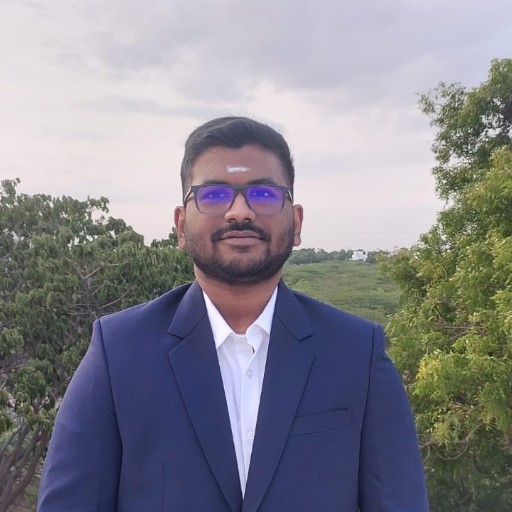
Surya Prakash Sankarakuthalam
Student @ VIT-AP University - Pre Final Year UG
Coimbatore, Tamil Nadu
ssuryaprakashcbe@gmail.com
Computer Science undergraduate with strong skills in Java, Python, data structures, algorithms, and software engineering. Experienced in building projects involving desktop applications, databases, and data analysis. Passionate about solving complex problems, learning new technologies, and developing scalable software solutions.
MonsoonIQ – Regime-Aware Rainfall Forecast Correction (SIH 2026)
Built an AI post-processing system for MoES (SIH26080) that bias-corrects NOAA GFS rainfall forecasts against IMD 0.25° observed data across 53 Indian districts, conditioning corrections on the monsoon regime via a mixture-of-experts model. Cut RMSE by 11% and improved heavy-rain detection (CSI) by 82% over raw GFS on held-out 2024–25 seasons, served through a FastAPI service and a React operations console with district warnings and auto-generated bulletins.
DoffMark – Yarn Cone Traceability & Mill IoT Platform
Built a traceability and machine-monitoring platform for ring-spinning mills where each yarn cone’s QR/NFC tag opens a live “cone passport” tracing it back to the ring frame, shift and fibre lot. Includes an edge gateway that polls PLCs over Modbus TCP and publishes via MQTT with offline store-and-forward, live floor monitoring with spindle heatmaps and alarms, packing/dispatch state machine, and complaint containment.
NeuroFuzzy-Screen – Trauma-Aware Depression & Anxiety Screening
Designed a three-stage soft-computing pipeline: a Genetic Algorithm selects the most informative survey questions, a calibrated multi-task neural network predicts depression and anxiety probabilities, and a Mamdani fuzzy inference system with a trauma (ACE) input produces an explainable 0–100 triage score. Trained on 86,503 adults harmonised from CDC BRFSS 2021 and NHIS 2019, served through a FastAPI backend and React dashboard with rule-level and what-if explanations.
Bachelor of Technology in Computer Science and Engineering (CORE)
VIT-AP University · 8.93
AWS Certified Cloud Practitioner (CLF-C02 - English)
Amazon Web Services
Oct 2026
Attendee · Oct 24, 2026